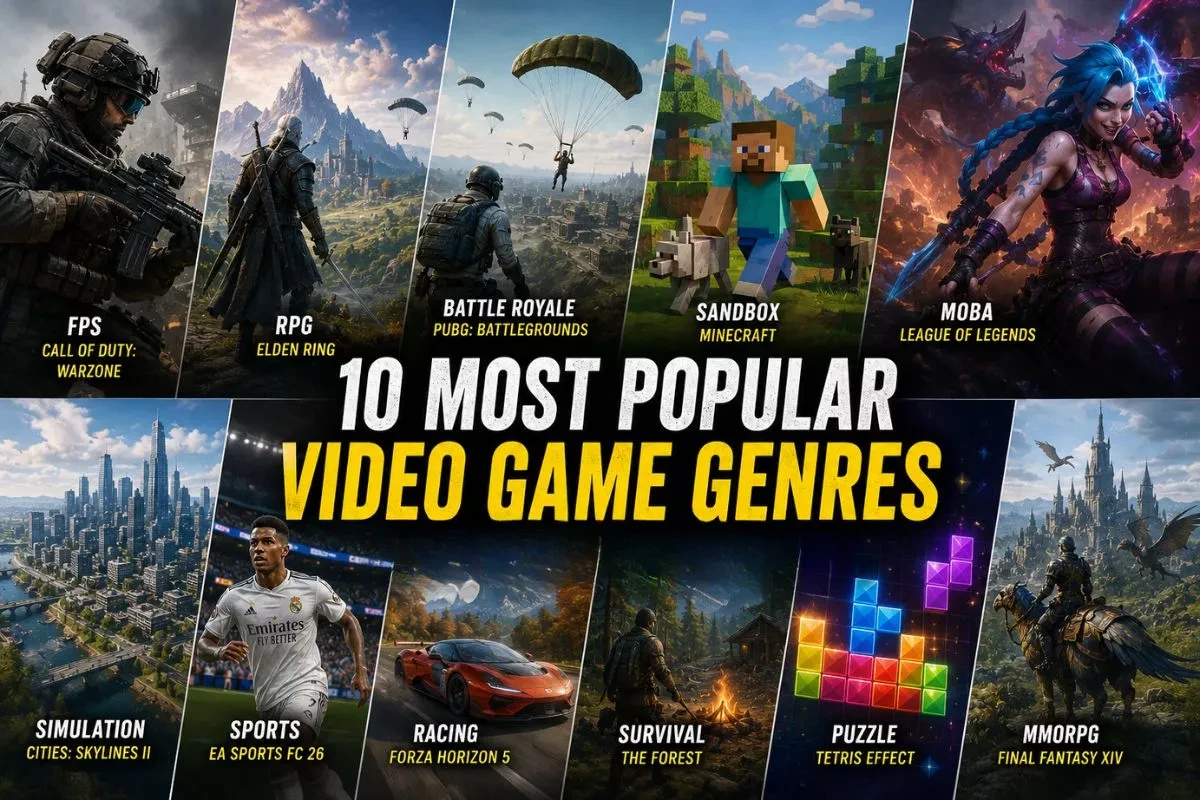
The action genre is the beating heart of the modern gaming industry. From blockbuster console releases to competitive esports titles, action games consistently dominate sales charts and cultural conversation alike. Yet “action” is a remarkably broad label. It encompasses everything from lightning-fast shooters to methodical stealth experiences, each built on distinct design philosophies that shape how players think, move, and react.
For developers, publishers, and technology professionals working in and around the games industry, understanding these genres is more than academic. It informs everything from engine architecture and netcode requirements to monetization strategy and hardware optimization. This guide breaks down the most popular action game genres, their defining mechanics, and the technical demands that set them apart.
What Defines an Action Game?
At its core, an action game prioritizes real-time player input as the primary driver of progress. Success depends on reflexes, timing, spatial awareness, and decision-making under pressure. Unlike strategy or role-playing games where planning and statistics can carry the day, action games demand that players physically execute their intentions through a controller or keyboard and mouse.
That said, genre boundaries are increasingly porous. Modern titles blend shooting, melee combat, exploration, and progression systems into hybrid experiences. The categories below represent the dominant archetypes rather than rigid boxes.
The Major Action Game Genres
First-Person Shooters (FPS)
The first-person shooter places the camera behind the player’s eyes, maximizing immersion and precision. Titles like Call of Duty, Halo, and Counter-Strike define the genre’s mainstream appeal, while Doom Eternal represents its high-velocity extreme.
Key characteristics include:
- Weapon-centric combat with aiming as the core skill
- Fast movement and twitch-based reaction windows
- Competitive multiplayer and ranked ladders as long-term engagement drivers
- Low time-to-kill in many competitive variants
Technically, FPS games are the most latency-sensitive genre in existence. Competitive players perceive input lag measured in single-digit milliseconds, which is why high refresh-rate displays, low-latency engines, and robust netcode are non-negotiable.
Third-Person Shooters (TPS)
Third-person shooters pull the camera back, showing the protagonist from behind or over the shoulder. This perspective enables stronger character expression, environmental awareness, and cinematic framing. Franchises such as Gears of War, The Last of Us, and Fortnite demonstrate the genre’s range.
The defining trade-off is visibility versus immersion. TPS games let players see threats outside their immediate forward view, encouraging cover-based tactics and flanking maneuvers rather than pure reflex duels.
Hack and Slash
Hack and slash games emphasize melee combat, combos, and crowd control. Devil May Cry, Bayonetta, and God of War exemplify the genre’s emphasis on stylistic expression and skill mastery. Combat systems often feature:
These games demand sophisticated animation blending and state machines. Every attack, cancel, and transition must feel responsive while remaining visually coherent.
Soulslike
Named after Demon’s Souls and Dark Souls, the soulslike genre fuses punishing difficulty with methodical combat and interconnected level design. Elden Ring and Sekiro: Shadows Die Twice pushed the formula to mainstream prominence.
Signature traits include stamina management, deliberate attack commitment, punishing death loops, and environmental storytelling. The genre’s difficulty is a design choice, not a barrier. It teaches through repetition and consequence.
Battle Royale
Battle royale games pit dozens or hundreds of players against each other in a shrinking arena until one remains. PUBG popularized the format, while Fortnite and Apex Legends refined it for broader audiences.
Design challenges are substantial:
- Massive concurrent player counts with stable performance
- Dynamic zone mechanics that force engagement
- Loot distribution that balances randomness and fairness
- Spectator and replay systems for competitive integrity
From an infrastructure standpoint, battle royale is among the most demanding genres. Servers must handle hundreds of concurrent entities while maintaining tick rates acceptable for competitive play.
Beat ‘Em Up
Beat ’em ups, or brawlers, focus on side-scrolling or arena-based melee combat against waves of enemies. Classic examples include Streets of Rage and Double Dragon, with modern revivals like Sifu refreshing the template.
The genre is deceptively simple. Managing enemy aggro, hitboxes, and crowd density requires careful tuning to keep encounters challenging without becoming unfair.
Character Action and Stylish Combat
Sometimes grouped with hack and slash, character action games prioritize expressive, skill-based combat with high mechanical ceilings. Metal Gear Rising: Revengeance and Nier: Automata showcase this style. The focus is on player creativity and mastery rather than raw progression.
Stealth Action
Stealth action games invert the typical power fantasy. Instead of confronting enemies head-on, players manipulate sightlines, sound, and timing. Metal Gear Solid, Dishonored, and Hitman define the genre.
These titles require AI systems capable of believable perception, memory, and communication between enemies. A single guard noticing a body can cascade into a full alert state, so the underlying behavior trees must be robust and predictable.
Genre Comparison at a Glance
| First-Person Shooter | Aim and reflexes | Very fast | Counter-Strike |
| Third-Person Shooter | Positioning and cover | Fast | Gears of War |
| Hack and Slash | Combo execution | Fast | Devil May Cry |
| Soulslike | Timing and patience | Methodical | Elden Ring |
| Battle Royale | Survival and tactics | Variable | Fortnite |
| Beat ‘Em Up | Crowd control | Moderate | Streets of Rage |
| Stealth Action | Observation and planning | Slow to moderate | Hitman |
Why Genre Literacy Matters
Understanding these genres is essential for anyone building, marketing, or analyzing games. Each category carries distinct expectations around input latency, frame pacing, animation responsiveness, and network architecture. A battle royale cannot be built on the same assumptions as a soulslike, and a stealth game lives or dies by its AI behavior systems.
As the industry continues to blend genres, the lines will blur further. Hybrids like Returnal, which fuses roguelike structure with third-person shooting, and Hi-Fi Rush, which merges rhythm mechanics with character action, prove that the most exciting innovations happen at the intersections.
For developers and technologists, the takeaway is clear: genre fluency is a competitive advantage. It shapes technical decisions, informs player expectations, and ultimately determines whether a game feels responsive, fair, and worth mastering.
Leave a Reply